


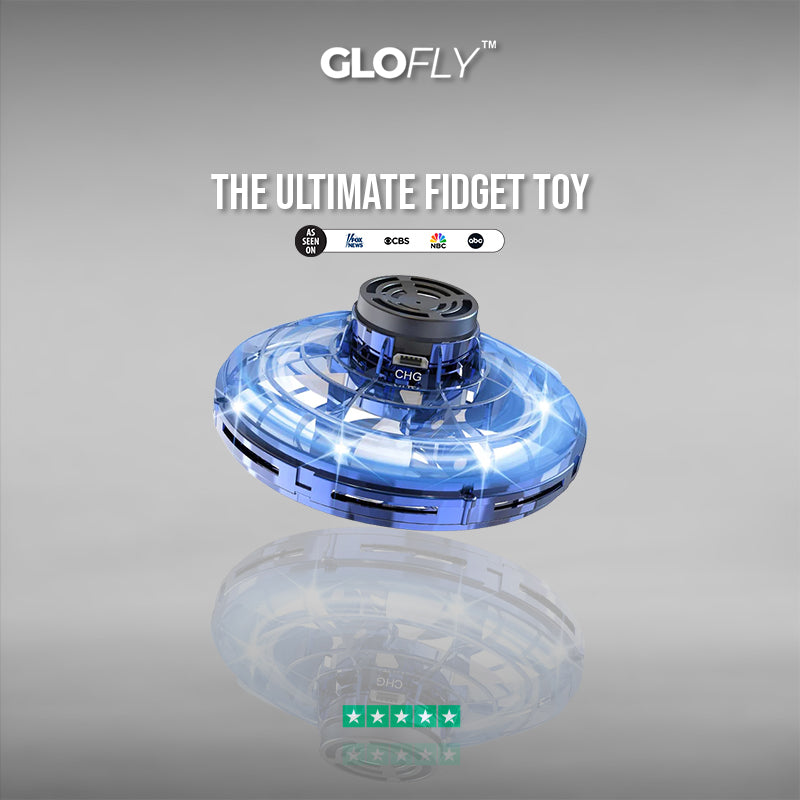
Hand-launched · gyro-stabilised
Throw it.
It comes
back.
A closed loop between your palm and thin air. Two seconds a cycle. Nobody throws it once.
No app · No remote · No controller
This is the whole product. Palm → air → palm.
Why this one
Four things
nobody
can copy.
Anyone can mould a plastic saucer and glue an LED to it. The loop is the hard part.
It chooses to come back
Angled vanes plus a weighted low centre of gravity bend the flight path into an arc. You throw forward. It curves home. Physics doing a magic trick.
Built to be dropped
The ribbed shell is a full impact cage around the blades, not trim. Concrete, tarmac, kitchen tile — it takes the hit, the blades don't, and nothing touches your fingers.
The light lives inside it
Translucent polycarbonate turns the whole body into a diffuser, so spinning colour smears into one solid ring of light. In the dark it stops being an object and becomes a trail.
No battery drawer
Integrated rechargeable cell with a visible CHG port. Plug it into the cable already on your desk. No coin cells, no screwdriver, no dead toy in a drawer by Tuesday.
Ships from local stock · Tracked
Spin speed blurs the zones into one solid ring.
The three-move loop
Ninety seconds
to your
first catch.
There is a learning curve. That's the point — the curve is where the dopamine is.
Spin it up
Flick the rotor and the gyro takes over. It holds its own axis before it ever leaves your hand.
Throw low and flat
Underhand, waist height, no force. Power is the beginner mistake. Angle is everything.
Open your palm
It arcs out, banks, and drops back into your hand. Then you do it four hundred more times.
Wide space, long arcs.
Hallways work. Ceilings forgive.
After dark
Lights out
is when it
gets loud.
Kill the room lights and it stops looking like a product. It becomes a moving light source other people follow with their heads.
Every throw leaves a trail your phone camera loves.
Straight answers
Ask the
awkward
questions.
Yes, and it will. Repeatedly. The ribbed outer shell is a structural impact cage that absorbs the landing so the rotor and blades never take direct force. Expect scuffs on the shell. Expect it to keep flying.
No. The blades sit fully recessed inside the enclosed vane housing — there is no exposed edge to reach. You catch the shell, never the rotor. It's designed to be caught barehanded hundreds of times a day, because that's the entire point of it.
Most people land their first clean catch inside two minutes. Throw underhand, keep it flat, and use far less force than instinct tells you. Over-throwing is the only real beginner mistake, and you'll fix it on attempt three.
Roughly 8–10 minutes of continuous flight — which sounds short until you realise flight time is measured in throws, and one throw is about two seconds. Charging is USB-C off any cable you already own, and it tops back up in well under an hour.
None of the above. No app, no Bluetooth, no controller, nothing to pair. Your hand is the input device. Take it out of the box, spin it, throw it.
Orders are picked and dispatched within 24 hours on business days. You get a tracking number by email the moment it leaves the warehouse — not a week later. Standard delivery runs 3–7 business days depending on your region.
Send it back within 30 days and you're refunded. No interrogation, no restocking fee, no argument about whether it was used. It's a flying object — obviously you flew it.
Kids love it. That isn't who keeps it. The people who don't put this down are adults with restless hands and a dead scroll. Recommended age 8+ due to small parts and rotating components.
30-day returns · Tracked dispatch in 24h
Nobody hands it back on the first ask.
Verified buyers
What happens
after it lands.
Last thing
You already
know how
this ends.
You throw it once to see if it works. Then you throw it again because it did.
Dispatch in 24h · 30-day returns · Tracked